
15 most photogenic spots in the UAE: light first, GPS second
The most photogenic spots in the UAE fail at noon haze. Fifteen locations, golden-hour windows, etiquette and source-backed tips for Dubai to Fujairah.
Key takeaways
- Light matters more than location: plan around golden and blue hour, because noon haze and heat flatten skylines.
- In Dubai, June 2026 sunsets fall around 7:04–7:12 pm and December sunsets around 5:28–5:39 pm; the UAE stays on UTC+4 with no daylight saving.
- Venue rules differ: Louvre Abu Dhabi is handheld-only with no flash in galleries, Qasr Al Watan caps tripods at 15 inches, and Jubail Mangrove Park charges AED 200 for personal shoots with professional-grade cameras.
- Museum of the Future is closed to visitors from September 2026, with a planned Q1 2027 reopening, so shoot the exterior only.
- West-facing Gulf beaches favour sunset; the East Coast favours sunrise.
Marble domes, desert lakes, and glass-clad towers always look promising on a map. Arrive under the glare of a midday Gulf sun—or step past a venue's designated photo-stop rope—and even the grandest landmark falls flat. Approaching the most photogenic spots in the UAE is a question of light and local protocol first, and a list of coordinates second.
Below, we map out the 2026 golden-hour windows across the Emirates, followed by fifteen standout locations stretching from Abu Dhabi's cultural waterfronts and Dubai's vertical canyons to the Hajar mountain bays of the East Coast, alongside the etiquette and legal boundaries that keep every shoot trouble-free. Where admission fees, tripod limits, or operating hours are cited, they come directly from official venue schedules—though you should always check ticket portals on the morning you travel.
While the Department of Municipalities and Transport's Keep Abu Dhabi Picture Perfect initiative (updated 15 December 2025) focuses on civic upkeep and urban cleanliness rather than scouting viewpoints, official tourism guidance from Experience Abu Dhabi and cultural calendar moments—such as Louvre Abu Dhabi's World Photography Day promotion on 17–18 August 2024—offer verified trails for photographers. This guide builds on those official records.
Golden hour first: haze and heat flatten skylines
In the Emirates, golden hour spans roughly the first hour after sunrise and the final hour before sunset, bookended by blue hour—the cool, cobalt twilight just before dawn and immediately after dusk when city lights balance against the sky. Because the sun's arc shifts noticeably between summer and winter, check the daily tables on timeanddate for Dubai or your nearest emirate before setting an alarm.
Approximate Dubai 2026 solar anchors from timeanddate illustrate the seasonal swing:
- June: sunrise sits around 5:27–5:31 am, with sunset stretching to 7:04–7:12 pm
- December: sunrise moves to roughly 6:47–7:03 am, with sunset arriving around 5:28–5:39 pm
Abu Dhabi follows almost identical rhythms: Experience Abu Dhabi's visitor FAQs note winter sunrises around 6:30–7:00 am and summer sunrises as early as 5:30 am, with evening sunsets near 7:00 pm. The UAE remains on Gulf Standard Time (UTC+4) year-round and does not observe daylight saving.
According to Experience Abu Dhabi, the cooler months from November to April deliver the crispest visibility. Summer brings suspended dust, coastal humidity that turns distant skylines into chalky silhouettes, and ambient temperatures that push past the 0–40°C operating rating of most camera bodies (see our guide to protecting cameras from heat, sand and humidity in the UAE). In warmer months, work the very edges of dawn and dusk along the coast or desert; if atmospheric haze thickens, step closer to your subject or wait for blue hour. When venue rules or narrow promenades rule out a tripod, strong in-body image stabilisation—such as the Sony α7R V, rated up to 8 stops (CIPA) across its 61-megapixel sensor—keeps handheld twilight exposures sharp.
Daylight in Dubai, June vs December 2026
The 15 spots (arrive for light, not only GPS)
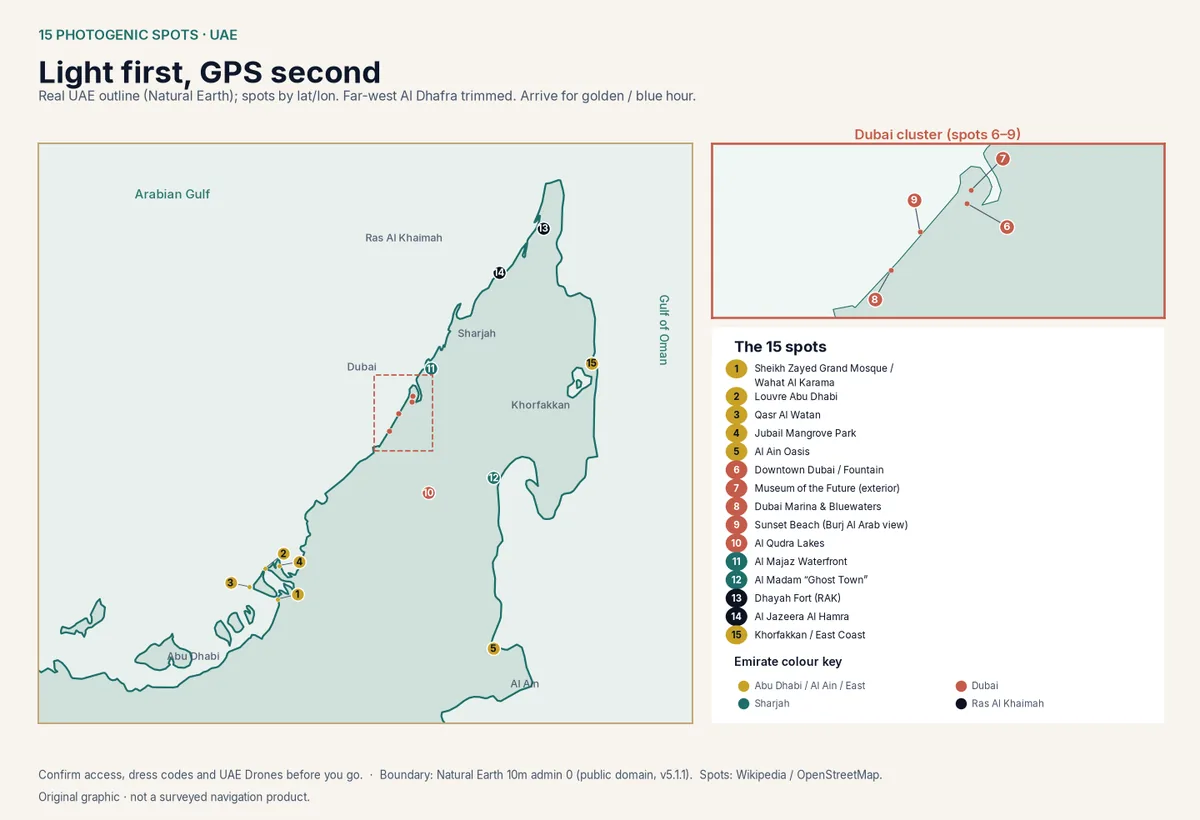
The 15 spots, placed by latitude and longitude. Boundary: Natural Earth (public domain). Schematic, not a navigation map.
1. Sheikh Zayed Grand Mosque and Wahat Al Karama (Abu Dhabi)
Clad in gleaming white Macedonia marble, surrounded by reflective pools and illuminated at night by a lighting system calibrated to the phases of the moon, Abu Dhabi's flagship sanctuary rewards careful timing. Experience Abu Dhabi recommends early mornings and late evenings, and points photographers across the footbridge to Wahat Al Karama for sweeping, crowd-free reflections.
- Best time: Early morning for soft, directional light across the marble colonnades; late afternoon into blue hour from Wahat Al Karama's shallow memorial pool. A wide zoom such as the Sony FE 16-35mm F2.8 GM II takes in the full courtyard geometry from the designated viewing points.
- Practical rules: Rely on the Centre's strict Visitor Code PDF rather than casual travel blogs. Women must wear loose attire covering to the ankles and wrists with full hair coverage; men should wear full-length trousers and avoid sleeveless or tight shirts. Personal photography is restricted to designated photo stops, while professional or commercial equipment requires advance written clearance from the Centre. Check seasonal visiting hours at szgmc.gov.ae.
2. Louvre Abu Dhabi (Saadiyat Island)
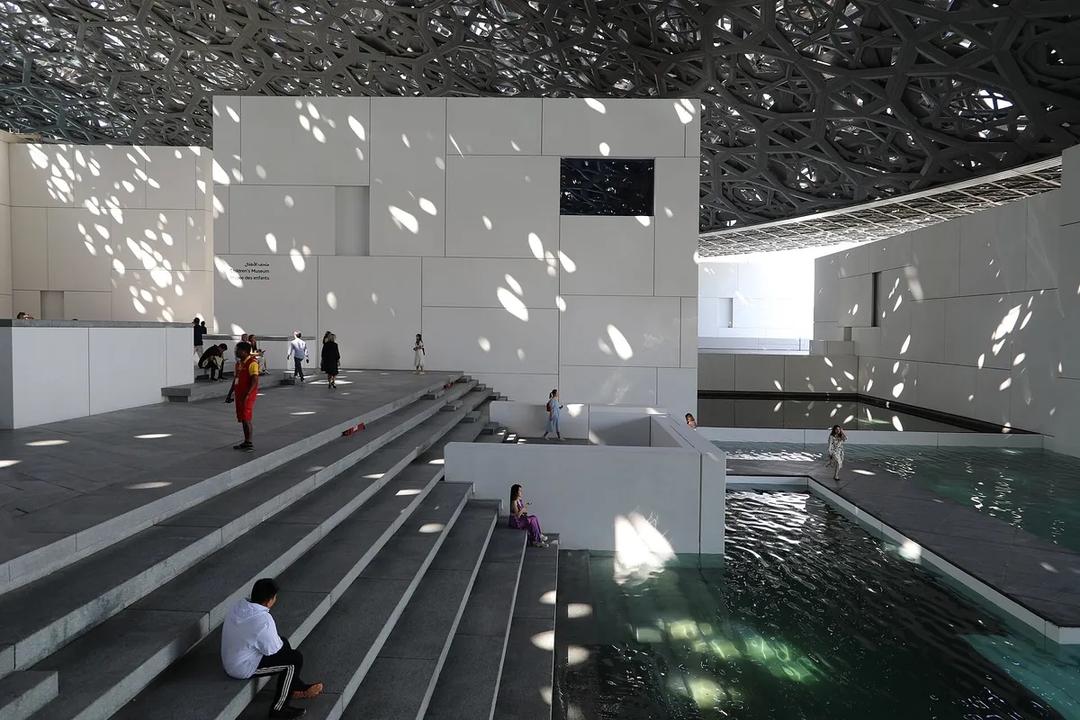
The “rain of light” under the dome. Photo: Francesco Bini (Sailko) / Wikimedia Commons, CC BY-SA 4.0.
Jean Nouvel's perforated geometric dome—pierced by roughly 7,850 star-like openings, as noted by Experience Abu Dhabi—filters fierce Gulf sunlight into a shifting cinematic "rain of light" across the plazas below. Nearby on Saadiyat Cultural District, architectural photographers are also tracking the upcoming Guggenheim Abu Dhabi photography rules.
- Best time: Mid-morning through early afternoon for dramatic sunbeams slicing beneath the dome; golden hour or blue hour outside for silhouettes against the Arabian Gulf. Because tripods are barred indoors, rely on in-body stabilisation and a braced stance.
- Practical rules: Under Louvre Abu Dhabi's official photography guidelines, visitor photography is strictly handheld only, with no flash in the galleries and no tripods or heavy supports inside; selfie sticks are permitted only outside the galleries or beneath the dome as specified. Photoshoots for commercial products or special occasions (including weddings, anniversaries, and graduations) are prohibited even when shot handheld. Accredited media and commercial productions must apply through the museum's press office before securing a permit. Confirm timed-entry tickets at louvreabudhabi.ae.
3. Qasr Al Watan (Abu Dhabi)
The working presidential palace on the Ras Al Akhdar peninsula pairs monumental white granite façades with intricate geometric interiors. Its official visitor guidelines welcome non-commercial photography and video, provided visitors observe modest dress (knees and shoulders covered; no flip-flops).
- Best time: Late afternoon for warm exterior reliefs, staying into the evening when the Palace in Motion light-and-sound projection runs (schedules vary seasonally, with last entry typically 30 minutes before the show). Keep security personnel and security systems completely out of your frame.
- Practical rules: Timed tickets are required. Non-commercial shooting is welcomed except with wearable devices indoors. Tripods are capped at a maximum length of 15 inches, and monopods are banned. Filming is prohibited around the rear palace compounds, during state visits, and inside the 100×100 m Great Hall. Verify current schedules on the Qasr Al Watan FAQ and opening hours page.
4. Jubail Mangrove Park (Abu Dhabi)
Elevated timber boardwalks wind through tranquil tidal channels and coastal avifauna on Jubail Island, offering an organic green counterpoint to the capital's marble and glass. Park wardens recommend early mornings, late afternoons, and high-tide windows when water fills the roots.
- Best time: Golden hour along the boardwalk curves; pack a circular polariser to cut surface glare on the water, and stay strictly on the decked path.
- Practical rules: According to the official Jubail Mangrove Park site, general admission is free, and standard park operating hours run from 8:00 am to 6:30 pm (with last entry at 5:30 pm, subject to Ramadan and public-holiday adjustments). Personal photoshoots using professional-grade cameras carry an AED 200 fee, while commercial shoots require advance management approval.
5. Al Ain Oasis (Al Ain)
Shaded by thousands of date palms and fed by the ancient UNESCO-listed falaj (aflaj) irrigation channels, Al Ain Oasis offers rare, dappled canopy light that remains workable well after the open desert has washed out. Experience Abu Dhabi suggests exploring on foot or by bicycle in the morning.
- Best time: Early morning for rich green saturation across the fronds, or late afternoon when long shadows rib the earthen pathways. Always ask consent before framing identifiable visitors or workers.
- Practical rules: Located roughly 1.5 hours inland from Abu Dhabi city per Visit Abu Dhabi. Check official municipal listings for gate timings before setting out.
6. Downtown Dubai: Burj Khalifa and Dubai Fountain
The signature vertical postcard of the Emirates, framed from the public waterfront promenades and bridges around Burj Lake.
- Best time: Blue hour into night, when ambient sky light still holds detail in the Burj Khalifa's cladding while the Dubai Fountain illuminates the foreground. Keep pedestrian bridges unobstructed. A fast telephoto zoom like the Sony FE 70-200mm F2.8 GM OSS II compresses the stacked architectural layers across the water.
- Practical rules: Handheld personal snapshots from public plazas are routine, whereas tripod setups on private mall terraces or any commercial production require Dubai filming permits. Review GCAA aviation notices and the UAE Drones portal before even packing an aircraft (see etiquette below).
7. Museum of the Future (exterior, Dubai)
Shaun Killa's stainless-steel torus inscribed with Arabic calligraphy remains one of Dubai's boldest architectural forms along Sheikh Zayed Road. According to the museum's official Get Help FAQ, the interior is closed to visitors from the beginning of September 2026, with reopening planned for Q1 2027, leaving the exterior facade unchanged for street-level photography.
- Best time: Late-afternoon golden hour for grazing side-light across the recessed calligraphy panels, followed by blue hour once the LED script lights up. Frame from public pavements; an ultra-wide zoom such as the Sony FE 12-24mm F2.8 GM captures the full curve of the torus from tight roadside setbacks.
- Practical rules: Plan for exterior architectural compositions only until the venue confirms its 2027 reopening date and updated indoor camera policies.
8. Dubai Marina and Bluewaters
High-rise residential canyons, moored yachts, and the open seafront linking JBR to Bluewaters Island and Ain Dubai.
- Best time: Sunset looking west toward the Gulf, transitioning into blue hour when the Marina's warm apartment windows reflect across the canal. On compact full-frame bodies like the Sony α7C II, activating Bright Monitoring boosts the electronic viewfinder gain in dim twilight so you can level horizons and compositions before locking your exposure.
- Practical rules: Stick to public promenades and avoid pointing long lenses at private yacht decks or residential balconies without permission.
9. Sunset Beach (Umm Suqeim) – Burj Al Arab view
The wide, public stretch of sand immediately west of the Burj Al Arab remains the cleanest shoreline angle on Dubai's sail-shaped icon.
- Best time: Evening golden hour through blue hour, when wet low-tide sand mirrors the sky and the hotel's facade. Arrive early enough to scout a clean shoreline lead-in so the tower doesn't sit isolated on a blank horizon.
- Practical rules: Open public beach; commercial lighting, stands, or crewed shoots require municipal and filming permits. Check GCAA and UAE Drones rules before considering aerials.
10. Al Qudra Lakes (Dubai)
Man-made desert oases outside the city where evening cyclists, migratory birds, seasonal greater flamingos, and rolling dunes meet (The National).
- Best time: Dawn for mirror-still water reflections; sunset for warm ochre dune crests behind the reeds. A super-telephoto zoom such as the Sony FE 100-400mm F4.5-5.6 GM OSS isolates wading flamingos and compressed desert ridges without leaving the shore track.
- Practical rules: Stay on established tracks, carry ample drinking water, and never flush or bait birds for a frame. If you plan to stay past nightfall, confirm current overnight camping regulations with Dubai Municipality.
11. Al Majaz Waterfront (Sharjah)
Sweeping corniche curves, landscaped gardens, and the Sharjah Musical Fountain across Khalid Lagoon offer classic waterfront reflections with far less congestion than Downtown Dubai.
- Best time: Sunset into blue hour, when the mosque domes and residential towers rimming Khalid Lagoon glow across the water.
- Practical rules: Open public park and promenade; standard UAE privacy laws apply—always obtain consent before taking identifiable portraits of families or passers-by.
12. Al Madam "Ghost Town" (Sharjah)
Rows of 1970s modernist houses and a neighbourhood mosque half-reclaimed by drifting red sand dunes near the Sharjah–Oman border—a haunting Gulf study highlighted in The National's feature on secret UAE photography locations.
- Best time: First light for crisp, raking shadows across the sand-filled doorways, or late afternoon when the iron-oxide dunes turn deep amber. Keep lens caps on and avoid changing glass in blowing wind.
- Practical rules: Site access has fluctuated in recent years, with periodic reports of perimeter gating or daylight-only entry. Verify current access status with Sharjah authorities before making the drive, leave no trace, and check GCAA status before contemplating any drone work.
13. Dhayah Fort (Ras Al Khaimah)
Described by Visit Ras Al Khaimah as the UAE's only remaining hilltop fort—and inscribed on the UNESCO World Heritage Tentative List—Dhayah's twin mud-brick battlements rise roughly 70 metres above a lush carpet of date-palm wadis between the Hajar cliffs and the sea.
- Best time: Late-afternoon golden hour, when low western sunlight warms the mud-brick walls against the dark mountain rock behind them, followed by a silhouette frame from the base of the hill after sunset.
- Practical rules: Dress modestly, keep to the stepped path, and never use flash against historic earthen surfaces. While Visit RAK's travel blog still notes that drones require a permit, the GCAA's current national suspension is far stricter—verify aviation rules before flying.
14. Al Jazeera Al Hamra (Ras Al Khaimah)
Recognised by Visit Ras Al Khaimah as the Gulf's only remaining historical pearling village (also on the UNESCO Tentative List), this preserved coastal settlement preserves coral-stone courtyard houses, windtowers, a fort, mosques, and narrow sikkas (alleyways). Visit RAK specifically highlights blue hour for bringing out the texture of the pale coral-and-gypsum walls.
- Best time: Early golden hour or blue hour, pairing wide architectural establishing shots with quiet studies of carved timber doors and coral masonry. A compact full-frame body like the Sony α7C II (approx. 33 MP with up to 7.0 stops of CIPA-rated IBIS) carries effortlessly through the village lanes.
- Practical rules: Observe modest dress, stay on marked routes, and never lean on or mark fragile coral walls. Apply the same strict GCAA drone caution as at Dhayah Fort.
15. Khorfakkan and the East Coast mountains (Sharjah and Fujairah coast)
Where Dubai and Abu Dhabi look west into the sunset, the UAE's East Coast faces the Gulf of Oman—putting the Hajar mountains at your back as the sun rises out of the water. Regional guides such as CityLaila single out Al Luluyah Beach and Khorfakkan Bay for dawn shoots, while The National highlights Fujairah valleys such as Wadi Abadilah when winter rains bring ephemeral pools and greenery.
- Best time: Dawn for warm coastal light hitting the sea stacks and mountain amphitheatre; scout elevated viewpoints such as Al Suhub Rest Area (Al Suhub Rest House) above Khorfakkan for sweeping bay compositions.
- Practical rules: Mountain wadis demand sturdy footwear, extra water, and a check of National Center of Meteorology alerts—never enter narrow wadi channels when rain is forecast in the Hajar catchment.
Camera rules at five of the spots
Where are you shooting?
Etiquette that keeps the shot legal (and shareable)
Illustration created with AI.
- People and privacy: Always ask permission before photographing identifiable individuals. Under Article 44 of Federal Decree-Law No. 34 of 2021 (the UAE Cybercrimes Law), using an information network or electronic device with intent to invade someone's privacy or family life without consent—including taking, storing, or publishing photographs—carries heavy statutory penalties, even if the image is unaltered. Read our full breakdown of UAE photography and privacy laws.
- Restricted and sensitive sites: Under Article 176 of the Federal Crimes and Penalties Law, it is an offence to photograph, sketch, or map sites where the competent authorities have prohibited photography. Rather than guessing where boundaries lie around defence, security, port, or critical infrastructure facilities, treat every posted "No Photography" sign as absolute law.
- Venue-specific codes: Respect each landmark's house rules—Sheikh Zayed Grand Mosque's dress code and designated photo stops, Louvre Abu Dhabi's handheld-only rule and ban on product or special-occasion shoots, Qasr Al Watan's 15-inch tripod cap and Great Hall restrictions, and Jubail Mangrove Park's AED 200 fee for personal shoots using professional cameras.
- Drones: Under the General Civil Aviation Authority's latest published notice—GCAA Safety Decision 2026-03, Issue 03, dated 27 April 2026—all unmanned aircraft operations are suspended unless you hold a written GCAA exemption. Because some general government information pages still summarise baseline recreational rules under CAR-UAR Issue 04 (and occasionally reference the retired "My Drone Hub" name), always verify current airspace status on the official UAE Drones platform and consult our guide to flying a drone in the UAE.
- Commercial permits, heat protection, and cultural venues: Before setting up tripods for a client or heading into the summer desert, review our guides on filming permits in Dubai and Abu Dhabi, protecting your camera from heat, sand and humidity, and Guggenheim Abu Dhabi photography.
Above all, keep the core rule in mind: light first, GPS second. Arriving at the wrong hour turns the finest landmark in the Emirates into a washed-out postcard.
Sources
- DMT — Keep Abu Dhabi Picture Perfect (15 Dec 2025): https://www.dmt.gov.ae/en/Media-Centre/News/DMT-Calls-on-Public-to-Keep-Abu-Dhabi-Picture-Perfect
- Experience Abu Dhabi — Instagrammable spots: https://visitabudhabi.ae/en/plan-your-trip/article-hub/instagrammable-spots-in-abudhabi
- Experience Abu Dhabi — FAQs (sun times, cooler months Nov–Apr, UTC+4): https://visitabudhabi.ae/en/faqs
- timeanddate — Dubai sunrise/sunset (Jun/Dec 2026): https://www.timeanddate.com/sun/united-arab-emirates/dubai
- Sheikh Zayed Grand Mosque Centre — Visitor Code (dress and designated photo stops): https://visit.szgmc.gov.ae/documents/terms-conditions/terms_abudhabi_en.pdf
- Louvre Abu Dhabi — Photography & Filming Guidelines: https://www.louvreabudhabi.ae/en/about-us/pressroom/photography-guidelines
- Qasr Al Watan — FAQ and visitor information / opening hours (tripod and zone rules): https://www.qasralwatan.ae/en/faq ; https://www.qasralwatan.ae/en/plan-your-visit/opening-hours
- Jubail Mangrove Park — official site (park operating hours; fees): https://www.jubailmangrovepark.ae/
- Visit Ras Al Khaimah — photography spots: https://visitrasalkhaimah.com/blog/photography-spots-ras-al-khaimah/
- The National — Hidden gems for photographers (21 Oct 2021; updated 7 Nov 2021): https://www.thenationalnews.com/arts-culture/art/2021/10/21/hidden-gems-of-the-uae-10-secret-spots-where-photographers-go-for-the-best-shots/
- CityLaila — Sunrise & sunset spots UAE: https://blog.citylaila.com/best-sunrise-sunset-spots-in-the-uae/
- Museum of the Future — Get Help (closure from beginning of Sep 2026; reopen Q1 2027): https://museumofthefuture.ae/en/get-help
- Time Out Abu Dhabi — Louvre World Photography Day offer (byline 16 Aug 2024; free entry 17–18 Aug 2024): https://www.timeoutabudhabi.com/news/louvre-abu-dhabi-world-photography-day
- Related guides on this site: UAE photography laws and flying a drone in the UAE
- Sony — α7R V (ILCE-7RM5) product page (61 MP; IBIS up to 8 stops, CIPA): https://electronics.sony.com/imaging/interchangeable-lens-cameras/full-frame/p/ilce7rm5-b
- Sony — FE 16-35mm F2.8 GM II (SEL1635GM2) specs: https://www.sony.com/electronics/support/lenses-e-mount-lenses/sel1635gm2/specifications
- Sony — FE 70-200mm F2.8 GM OSS II (SEL70200GM2) specs: https://www.sony.com/electronics/support/lenses-e-mount-lenses/sel70200gm2/specifications
- Sony — FE 12-24mm F2.8 GM (SEL1224GM) specs: https://www.sony.com/electronics/support/lenses-e-mount-lenses/sel1224gm/specifications
- Sony — FE 100-400mm F4.5-5.6 GM OSS (SEL100400GM) specs: https://www.sony.com/electronics/support/lenses-e-mount-lenses/sel100400gm/specifications
- Sony Help Guide — Bright Monitoring (ILCE-7CM2 / α7C II): https://helpguide.sony.net/ilc/2360/v1/en/contents/0414H_bright_monitoring.html
- Sony — α7C II (ILCE-7CM2) specs (approx. 33 MP; IBIS up to 7.0 stops, CIPA): https://www.sony.com/electronics/support/e-mount-body-ilce-7-series/ilce-7cm2/specifications
- GCAA — Safety Decision 2026-03 Issue 03 (27 Apr 2026): https://www.gcaa.gov.ae/en/epublication/EPublications/Safety%20Decisions/2026/2035-SAFETY%20DECISION%202026-03%20-%20TEMPORARY%20SUSPENSION%20OF%20UNMANNED%20AIRCRAFT%20SYSTEMS%20DRONES%20LIGHT%20SPORT%20AIRCRAFT%20AND%20BALLOON%20-%20ISSUE%2003.pdf
- UAE Drones platform: https://drones.gov.ae/
Frequently asked questions
What are the most photogenic spots in the UAE for beginners?
Sheikh Zayed Grand Mosque (paired with Wahat Al Karama across the road), Louvre Abu Dhabi's exterior plazas and dome light, Dubai Marina at blue hour, Sunset Beach for classic Burj Al Arab framing, and Sharjah's Al Majaz Waterfront offer high visual rewards with straightforward public access.
When is golden hour in Dubai or Abu Dhabi?
It shifts across the calendar. In Dubai during June 2026, sunrise falls near 5:30 am and sunset after 7:00 pm; in December, sunrise sits near 7:00 am with sunset around 5:30 pm (timeanddate). Abu Dhabi follows nearly identical times on UTC+4.
Can I use a drone at these locations?
The latest published GCAA notice (Safety Decision 2026-03, Issue 03, dated 27 April 2026) suspends drone flights nationwide unless you hold a written GCAA exemption, so always verify current status before flying, even where older tourism pages still describe standard recreational permits. Recreational camera drones also remain tightly restricted under CAR-UAR Issue 04. Check the official UAE Drones platform (drones.gov.ae) and plan terrestrial shots unless your written authorisation is in hand.
Is street photography legal in the UAE?
Photographing public skylines and architecture is generally fine, provided no prohibitory signs apply. Photographing identifiable people without consent is not a free-for-all: asking permission is the safe default, as capturing or publishing someone's image without consent can trigger liability under Article 44 of the Cybercrimes Law when the statutory electronic-means and intent elements apply.
Which emirate is best for sunrise versus sunset?
West-facing Arabian Gulf coastlines in Dubai, Abu Dhabi, Sharjah, Ajman, Umm Al Quwain, and Ras Al Khaimah naturally favour sunset over the water, whereas the East Coast along Khorfakkan and Fujairah faces the Gulf of Oman and excels at sunrise. Inland desert dunes and oases work well at either end of the day.
Do I need a permit for personal photos at the Louvre or Qasr Al Watan?
Personal, non-commercial handheld photography is welcomed under each venue's visitor guidelines (no tripods or flash inside Louvre Abu Dhabi's galleries; Qasr Al Watan caps tripods at 15 inches and bans monopods). However, Louvre Abu Dhabi prohibits commercial product and special-occasion shoots (such as weddings or graduations) even when shot handheld, and any commercial filming at either landmark requires advance written approval.
Where should I shoot in extreme summer heat?
Focus on dawn coastal sessions, air-conditioned architectural interiors such as Louvre Abu Dhabi and Qasr Al Watan, early-morning boardwalks at Jubail Mangrove Park, or blue-hour cityscapes after sundown. Keep spare batteries shaded and never leave camera gear inside a parked vehicle.

About the editor
Nicole spent five years working in the Middle East, so the region is familiar ground. Producing is what she loves most: bringing the plan, the people and the shoot together.
Related stories
AI filmmaking UAE: the camera still wins
AI filmmaking UAE after Dubai’s US$1M AI Film Award and Yas Creative Hub AI programmes. Where a real camera still wins, and hybrid skills to stack.
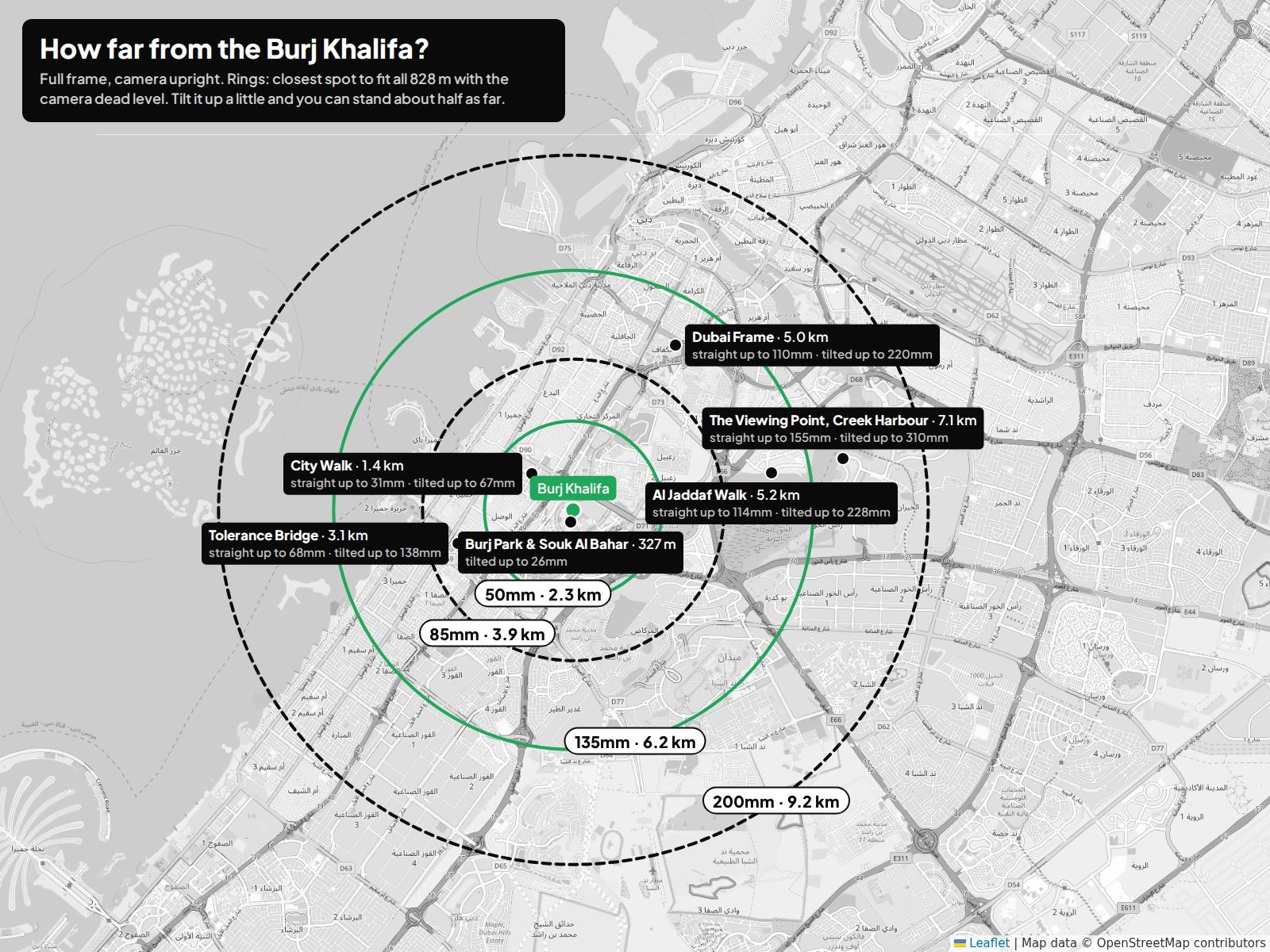
How far from the Burj Khalifa do you need to stand for each lens?
The exact distance to fit all 828 m of the Burj Khalifa in one photo with 16mm to 200mm lenses, two rules of thumb, and seven Dubai viewpoints.
How to photograph boats at the Abu Dhabi International Boat Show: tame the glare, then go tight
How to photograph boats at the Abu Dhabi International Boat Show, 19 to 22 November 2026: a polarising filter for glare, detail shots, marina light and consent.