
Moon Jupiter conjunction November 2026: how to photograph it from the UAE with a Moon frame and a planet frame
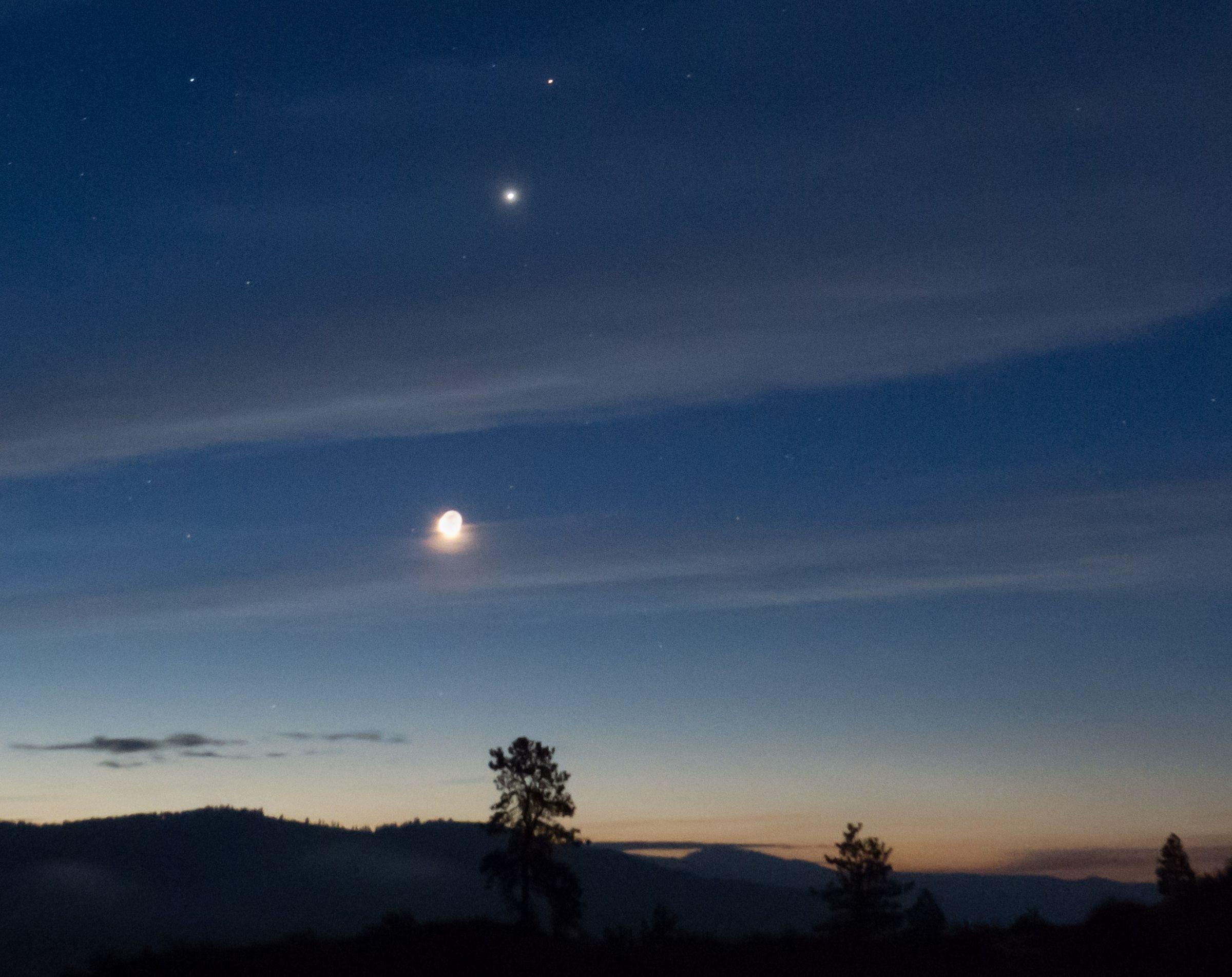
Moon Jupiter conjunction November 2026: how to photograph the Moon, Jupiter, Mars and Regulus before dawn on 30 Nov from the UAE, with a bracket plan.
Key takeaways
- Gulf News, quoting Emirates Astronomy Society chairman Ibrahim Al Jarwan, says the Moon appears near Jupiter and Regulus on Monday 30 November 2026, visible to the naked eye under clear skies; Star Walk adds Mars.
- Star Walk says the waning Moon, about 60% lit, Jupiter, Mars and Regulus fit inside a circle about 5.2 degrees across at their most compact.
- No UAE source we could open gives a clock time, so read rise times on Dubai Astronomy Group's Sky Tonight page and Dubai sunrise on the IACAD Prayer Times page.
- No single exposure serves both: plan Moon frames, planet and star frames, and bracketed in-between frames on a tripod, then compare or blend them.
- The occultations Star Walk lists are seen from Chile, Argentina and New Zealand; from the UAE this is a close grouping.
Finding the Moon, Jupiter, Mars and Regulus together is the easy part. The hard part is that the Moon is far brighter than everything around it. Star Walk puts it plainly: "an exposure that shows Mars and Regulus clearly may turn the lunar disk completely white." So the plan for the moon jupiter conjunction in November 2026 is a bracket: one set of frames for the Moon, another for the planets and the star, all on a tripod, taken before the sky brightens.
The date is Monday 30 November 2026. Gulf News, quoting Ibrahim Al Jarwan, Chairman of the Emirates Astronomy Society, reports that on 30 November the Moon will appear near Jupiter and Regulus, visible to the naked eye under clear skies "provided viewing conditions and the horizon are suitable." Star Walk adds Mars to the group. One limit up front: none of the UAE sources we could open gives a clock time for this gathering, so this guide doesn't print one. It shows where to read the UAE time yourself, and how to shoot once you're out there. Weather isn't guaranteed, and the settings below are starting points, not test results.
What is happening on 30 November, and who says so
Gulf News and the Emirates Astronomy Society. The Gulf News piece of 16 November, by Huda Ata, draws on Al Jarwan's comments to Al Khaleej. It names the Moon, Jupiter and Regulus, the brightest star in Leo, for 30 November, with no hour. Al Jarwan also says Jupiter is bright after midnight and in the early morning sky in November, and that Mars is visible after midnight and before sunrise.
Star Walk. Star Walk, from app maker Vito Technology, says Jupiter, Mars, Regulus and the waning Moon, about 60% lit, fit inside a circle about 5.2 degrees across at their most compact, about half the width of your fist at arm's length. It lists Jupiter at magnitude -2.2, Mars at 0.5 and Regulus at 1.4, where lower numbers are brighter, so Regulus is the faintest of the four.
How compact is the 30 November grouping?
- circle holding the Moon, Jupiter, Mars and Regulus at their most compact
- About 5.2°
- width of the Moon itself
- About 0.5°
- of the waning Moon lit
- About 60%
- comparable gatherings from 1900 to 2099, by Star Walk's own rules
- 7
Star Walk also calls the gathering rare. It searched 1900 to 2099 for groups where both planets are at least as bright as November's Jupiter and Mars and the star is at least as bright as Regulus, and found seven. It says the next one on its list that can be seen against a dark sky is 18 November 2052. Treat that as Star Walk's count under its own rules. The 5.2 degrees is measured from the centre of the Earth, and Star Walk says your local view can differ.
What you won't see: Star Walk places the Moon's occultations of Jupiter in Chile and Argentina and of Regulus in New Zealand, not the UAE. From here you're shooting a close grouping, not a planet disappearing behind the Moon.
When to go: the UAE clock times this guide cannot give you
- Gulf News and Al Jarwan give the date and stress clear skies and a suitable horizon. They give no UAE rise time, height or best minute for the group.
- Dubai Astronomy Group (DAG), which calls itself the UAE's leading astronomy organisation, listed events from 12 December (the Geminids) on its homepage when we checked on 25 November 2026, and its news page's latest item was dated 30 September. We found no DAG note or event for 30 November.
- Star Walk's table of best viewing times covers Los Angeles, New York, London, São Paulo, Tokyo and Sydney, with no UAE city. Do not copy those clock times.
- Star Walk says the best view may come before dawn on 30 November or during the night of 30 November to 1 December, depending on location. For the UAE, we have no source that says which.
So check these yourself, the night before and on the morning:
| Question | Where to check | What it gives you |
|---|---|---|
| When do the Moon and planets rise, and how high are they? | DAG's Sky Tonight page | DAG describes it as real-time planetary visibility for the UAE, updated every minute, showing rise and set times, altitude now, sunrise and twilight. It shows the current sky, so open it on the morning itself. |
| When does the sun come up? | The Prayer Times page of Dubai's Islamic Affairs and Charitable Activities Department | It lists Dubai prayer times, including sunrise. We couldn't read a 30 November value from it when writing, so read it for the day. |
| What will the group look like from my spot? | The Star Walk 2 app, Time Machine | Star Walk suggests comparing 30 November and 1 December and looking for a time when the group is above your horizon and the sky is dark. |
Our own advice, not a sourced figure: be set up, focused and tested before the sky starts to brighten ahead of sunrise, then keep shooting while the Moon moves. Star Walk notes it moves noticeably hour to hour.
Choose a spot: desert edge or city edge
A desert edge or other dark site gives Regulus, the faintest of the four by Star Walk's magnitudes, the best chance against less city glow. That's our reasoning, not a sourced finding. A city edge gives you something to put under the sky. BBC Sky at Night Magazine's conjunction guide says to check the objects' separation and the altitude of the scene in a stargazing app, and to make sure no foreground object blocks your view.
Brightness of the three companions (lower is brighter)
- Jupiter, the brightest of the three and the easiest to focus on
- Mag. -2.2
- Mars
- Mag. 0.5
- Regulus, the brightest star in Leo and the faintest of the four
- Mag. 1.4
Pick a public viewpoint you already know. Our Leonid meteor shower guide covers dark sites, desert safety steps and long-exposure sky basics, so we're not repeating them. If you go into the desert, read it first and tell someone your plan.
Which lens, and how much sky to include
BBC Sky at Night Magazine notes the Moon itself is only about half a degree across, so on a wide-field frame it looks small, and a longer focal length is often needed to catch a nearby planet too. Astrobackyard gives two ranges: a wide lens of 14 to 35 mm to include the landscape, and a telephoto of 85 to 200 mm to zoom in on the planets. As a starting plan, take a wide lens for the full scene and, if you own one, a mid telephoto for a tighter frame.
You don't have to guess how much sky a lens covers. DAG's Sky Tonight page includes a field of view calculator for cameras, binoculars and telescopes. Enter your gear and compare it with the group's width before you leave home.
Use a tripod; BBC and Astrobackyard both recommend one. BBC also gives the 500 rule against star trailing: divide 500 by your focal length for the longest exposure before trailing shows. Astrobackyard's example is that a 50 mm lens should stay under 10 seconds. Shoot RAW, as NASA's lunar photography guide advises. Focus manually: Astrobackyard suggests a bright star or planet in live view at 10x zoom, and Jupiter is the brightest of the three companions by Star Walk's magnitudes. On a Sony Alpha 7 V, for example, the Help Guide's Focus Magnifier enlarges the image before you shoot, and in Manual Focus you can adjust focus while Jupiter is magnified; each press of the centre of the multi-selector changes the magnification.
The exposure gap: a bracket plan for the Moon and the planets
This is the heart of the shoot. The planets need much longer exposures than the Moon, so no single setting serves both. Star Walk's advice is to take shorter exposures for the Moon's surface and longer ones for the surrounding objects, then compare the results. Plan two main groups of frames, plus a safety net:
| Frame group | What you want | Starting points from published guides |
|---|---|---|
| Planet and star frames | Jupiter, Mars and Regulus clear, Moon allowed to clip | Astrobackyard's wide-field starting point: manual mode, the widest aperture your lens allows (it names f/2.8), ISO 800 to 1600, 2 to 10 seconds, shorter for a telephoto and longer for a wide lens, within the 500 rule |
| Moon frames | The disc keeps grey tone and some surface texture | Far faster shutter speeds. Jim Doty, in a Moon and planets guide, suggests 1/500 to 1/1000 second for a better Moon exposure than the planet frames give |
| In-between frames | A safety net across the gap | Astropix suggests bracketing 1, 2 and 3 stops under and over what the meter suggests |
The bracket plan: starting points, not test results
These come from different sources and skies, so treat them as the start of a search. Check the histogram and change one setting at a time. If the Moon frame still clips, shorten the shutter. If Mars and Regulus vanish in the planet frame, lengthen it or raise ISO within what your camera handles cleanly.
For one picture with everything exposed, blend the frames in software. Astrobackyard says an HDR approach is useful when the Moon is part of the conjunction, because its brightness can overwhelm the planets. Our supermoon guide covers Moon-disc exposure basics, so we're not repeating them. Remember the Moon here is waning, about 60% lit by Star Walk's figure, not full.
Save both exposures so you can switch in the dark
Many cameras can store exposure settings for quick recall. Sony's Alpha 7 V Help Guide, as one example, describes Recall Camera Setting: registered settings come back on mode dial positions 1, 2 or 3. On the Alpha 7 V, register a planet setup in one slot and a Moon setup in another, and you can switch in the dark without menus. The Alpha 7 V's Interval Shoot Func. shoots a series of stills at an interval and count you set in advance, which suits a run of frames across the morning, and on a tripod it keeps the framing identical. The Alpha 7 V allows an interval of 1 to 60 seconds, counted from the start of one exposure to the next. Check your own manual for equivalents and the allowed interval range.
Phones: steady support, then expect test shots
Star Walk says to try a phone held steady on a support, using manual or night settings, and to expect a few test shots. Apple's Night mode guidance is to hold the iPhone still, with a tip to use a tripod for more detail.
The same exposure gap applies. Apple's camera guide says you can tap where you want to move the focus area and drag to adjust the exposure. NASA's phone checklist says to touch the Moon to focus on it, and lower the brightness so it looks grey, not white. Take one frame that way for the Moon, then a brighter frame for the rest of the group, with the timer on so you don't jostle the phone.
The second frame, an hour later
Star Walk's advice here is simple: if you stay out for a while, take another photo an hour later and look at how the Moon has moved relative to Regulus. You may be able to record the group changing shape over the morning.
In practice, leave the tripod where it is. Do not change the lens, zoom or angle between frames, so the stars stay put and only the Moon appears to shift. When you edit, put the two frames side by side, or layer them, to show the Moon's shift against Regulus. That layering is our suggestion, not Star Walk's.
If the sky is hazy or cloudy
This article doesn't forecast the weather for 30 November. Haze may dim Regulus first, our reasoning and not a sourced finding, but thin haze can still make a good picture with a pale Moon. Our dust and haze photography guide covers how haze behaves in a frame.
BBC Sky at Night Magazine's advice for a poor forecast is to check how close the objects will be before and after the closest date, noting that for planets the difference may not be significant. The Moon moves quickly, as Star Walk notes, so it differs. Check the forecast the night before and decide whether to go.
Sources
All accessed on 25 November 2026.
- Gulf News: UAE skies to light up with Winter Triangle and planetary encounters this November (16 November 2026; Ibrahim Al Jarwan, Chairman of the Emirates Astronomy Society)
- Al Khaleej: Arabic original of the Emirates Astronomy Society report (16 November 2026)
- Star Walk: Moon, Jupiter, Mars, and Regulus, a rare sky gathering on Nov 30, 2026 (11 November 2026)
- Dubai Astronomy Group: homepage (no note or event for 30 November when checked)
- Dubai Astronomy Group: Astronomy news (latest item dated 30 September 2026 when checked)
- Dubai Astronomy Group: Sky Tonight (real-time planetary visibility for the UAE; field of view calculator)
- Islamic Affairs and Charitable Activities Department, Dubai: Prayer Times
- BBC Sky at Night Magazine: How to photograph a conjunction of planets and the Moon (Pete Lawrence, 18 March 2026)
- Astrobackyard: How to Photograph Planetary Conjunctions
- Astropix, Jerry Lodriguss: Wide-Angle Single Frame (bracketing)
- Blog.JimDoty.com: How to Photograph Jupiter, Saturn, Venus, and the Moon
- NASA Science: Lunar Photography Guide
- Apple Support: Take Night mode photos with your iPhone camera
- Apple Support: Use iPhone camera tools to set up your shot
- Sony Alpha 7 V (ILCE-7M5) Help Guide: Recall Camera Setting
- Sony Alpha 7 V (ILCE-7M5) Help Guide: Interval Shoot Func.
- Sony Alpha 7 V (ILCE-7M5) Help Guide: Focus Magnifier
Frequently asked questions
When can I see the Moon and Jupiter together from the UAE, and at what time?
Gulf News, quoting the Emirates Astronomy Society's Ibrahim Al Jarwan, dates the Moon's meeting with Jupiter and Regulus to 30 November, visible to the naked eye under clear skies with a suitable horizon. It gives no hour, and DAG's website carried no note for 30 November when we checked on 25 November. Use DAG's Sky Tonight page on the day for rise times and height, and the IACAD Prayer Times page for Dubai sunrise.
Can I see the Moon cover Jupiter or Regulus from the UAE?
No source we found says so. Star Walk places the Jupiter occultation in Chile and Argentina and the Regulus occultation in New Zealand. From the UAE, expect a close grouping.
How rare is this gathering, according to Star Walk?
Star Walk found seven comparable gatherings between 1900 and 2099 under its own brightness rules, and names 18 November 2052 as the next dark-sky one on its list. That's Star Walk's count, not an official ranking.
What camera settings should I start with for the Moon and planets?
Treat these as a search, not a recipe. For planet frames on a tripod, Astrobackyard suggests the widest aperture, ISO 800 to 1600 and 2 to 10 seconds, within the 500 rule. For the Moon, Jim Doty suggests 1/500 to 1/1000 second. Bracket 1, 2 and 3 stops either side, as Astropix suggests.
Can I photograph the Moon and planets with my phone?
Star Walk says to try a phone held steady on a support, using manual or night settings, and to expect a few test shots.
What if it is cloudy or hazy?
This article isn't a forecast. Check the forecast the night before, and see our dust and haze guide for how haze changes a frame.

About the editor
Wessel has worked in technology for more than 25 years and manages social media for some of the world's biggest brands. He knows which gear earns its place in a working creator's bag.
Related stories
How to photograph the supermoon: the UAE's Beaver Moon rises before sunset on 24 November
How to photograph the supermoon in the UAE on 24 November: Dubai moonrise 5:06 pm, disc exposure, foregrounds, and DAG's night at SEE Institute.
How to photograph the Leonid meteor shower UAE in a modest year
How to photograph the Leonid meteor shower UAE in 2026: which nights sources name, Dubai moonset times, camera settings, dark-sky spots and desert safety.
How to take concert photos with phone at UAE arenas, and what each venue allows
How to take concert photos with phone at UAE arenas: expose for faces, skip the flash, plus official rules at Coca-Cola, Etihad and Space42.