
How far from the Burj Khalifa do you need to stand for each lens?
The exact distance to fit all 828 m of the Burj Khalifa in one photo with 16mm to 200mm lenses, two rules of thumb, and seven Dubai viewpoints.
Key takeaways
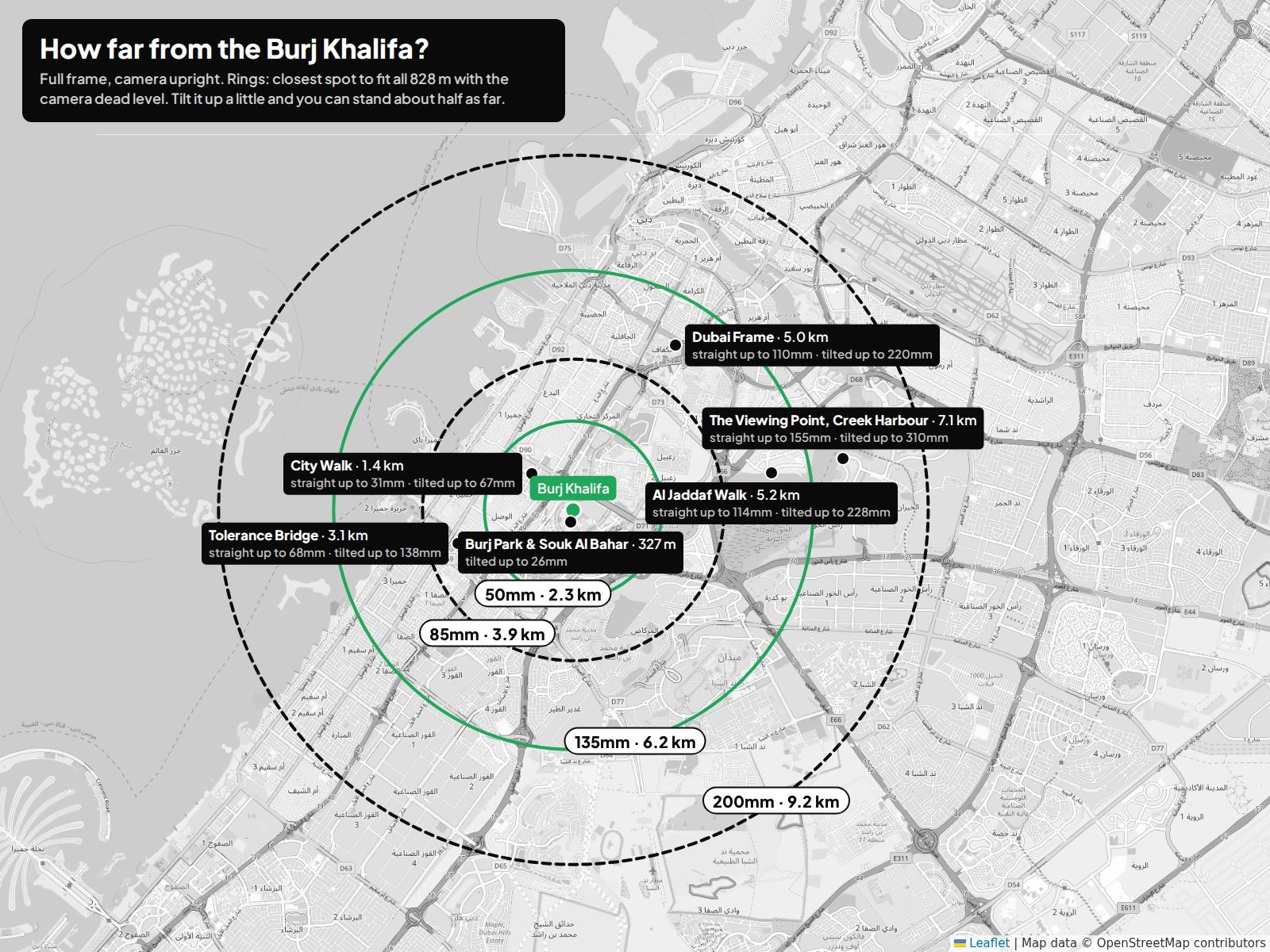
- On a full-frame camera held upright, stand about 46 metres per millimetre of focal length to keep the Burj Khalifa straight: 24mm needs 1.1 km, 50mm needs 2.3 km and 200mm needs 9.2 km.
- Tilt the camera up and about 23 metres per millimetre is enough for longer lenses: 85mm needs 1.9 km, 135mm needs 3.1 km and 200mm needs 4.6 km.
- A 16mm lens held upright on full frame has a vertical field of view of 96.7 degrees, so tilted it fits the whole tower from anywhere, even at its base.
- For 135 to 200mm, The Viewing Point at Dubai Creek Harbour (7.1 km) works: 135mm fits straight, 200mm with a 2 to 5 degree tilt.
- Beyond about 1 km at ground level, other towers usually hide the lowest floors, so the bottom of the frame is skyline, not the tower's base.
"How far back do I need to be to get the whole Burj Khalifa in?" is one of the most common questions photographers ask in Dubai, and the usual answers are vague: use a wide lens, go to Business Bay. This guide gives the exact distance for every common lens, two rules of thumb you can remember, and seven real viewpoints with the longest lens that works from each.
"The whole tower" here means the full 828 m, ground to tip, inside the frame. All distances were calculated by Camerahub for this article.
The short answer
With a full-frame camera held upright (portrait):
- To keep the tower dead straight, stand about 46 metres away for every millimetre of focal length. A 24mm needs 1.1 km, a 50mm needs 2.3 km and a 200mm needs 9.2 km.
- If you tilt the camera up, about 23 metres per millimetre is enough for longer lenses. An 85mm needs 1.9 km, a 135mm needs 3.1 km and a 200mm needs 4.6 km. With a telephoto the tilt is only 5 to 12 degrees, so the tower barely leans.
Two rules of thumb (full frame, camera upright)
- per millimetre of focal length, camera level (tower dead straight)
- 46 m
- per millimetre, camera tilted up (85mm and longer)
- 23 m
So remember two numbers: 46 metres per millimetre to keep the tower straight, 23 metres per millimetre if you tilt.
Straight or tilted: what the two numbers mean
Straight (level) means the camera isn't tilted. The tower stays perfectly vertical, but its base sits just below the middle of the frame, so the bottom half of the picture is foreground: water, road or skyline. That's a good composition, not a problem.
Tilted means you point the camera up until the base touches the bottom edge. You can stand about half as far away, but the tower leans backwards (converging verticals). How much depends on the tilt. With a wide lens it's 30 to 48 degrees and the lean is obvious; with 135mm or longer it's 5 to 8 degrees and hardly visible. You can straighten it afterwards in Lightroom or Photoshop, losing some of the frame. A tilt-shift lens is the other way to keep the verticals straight from closer.
Every distance in the tables is a tight fit: the tip touches the top edge. For breathing room, stand about 10% further back (the "with room" column).
The calculations assume the tower's 828 m height to the tip (Emaar's fact sheet), a camera at eye height, 1.6 m above the ground the tower stands on, a full-frame sensor of 36 x 24 mm and a Sony APS-C sensor of 23.5 x 15.6 mm. The Council on Tall Buildings and Urban Habitat lists the tip at about 829.8 m; that difference changes the distances by less than 0.3%.
Distance chart for full-frame cameras
For full-frame bodies such as the Sony A7 IV, A7C II or FX3.
Closest spot to fit the whole tower, camera level (full frame, upright)
| Lens | Portrait, straight | Portrait, straight, with room | Landscape, straight | Portrait, tilted | Tilt needed | Landscape, tilted |
|---|---|---|---|---|---|---|
| 16mm | 735 m | 816 m | 1,102 m | anywhere (field of view wider than 90°) | up to 48° | 247 m |
| 20mm | 918 m | 1,020 m | 1,377 m | 101 m | 42° | 445 m |
| 24mm | 1,102 m | 1,224 m | 1,653 m | 247 m | 37° | 623 m |
| 35mm | 1,607 m | 1,785 m | 2,410 m | 594 m | 27° | 1,067 m |
| 50mm | 2,296 m | 2,551 m | 3,443 m | 1,002 m | 20° | 1,626 m |
| 85mm | 3,902 m | 4,336 m | 5,854 m | 1,868 m | 12° | 2,875 m |
| 135mm | 6,198 m | 6,887 m | 9,297 m | 3,050 m | 8° | 4,621 m |
| 200mm | 9,182 m | 10,202 m | 13,773 m | 4,563 m | 5° | 6,875 m |
A fun one: a 16mm lens held upright on full frame has a vertical field of view of 96.7 degrees, wider than 90. Tilted, it fits the whole tower from anywhere, even standing at its base. The tower will lean back dramatically.
Distance chart for Sony APS-C cameras
For APS-C bodies such as the Sony ZV-E10 II, A6700 or FX30. Use the focal length written on the lens: the table already includes the crop, so don't multiply again.
| Lens | Portrait, straight | Portrait, straight, with room | Landscape, straight | Portrait, tilted | Landscape, tilted |
|---|---|---|---|---|---|
| 16mm | 1,125 m | 1,250 m | 1,695 m | 265 m | 649 m |
| 20mm | 1,407 m | 1,563 m | 2,119 m | 464 m | 902 m |
| 24mm | 1,688 m | 1,876 m | 2,543 m | 645 m | 1,140 m |
| 35mm | 2,462 m | 2,735 m | 3,708 m | 1,095 m | 1,766 m |
| 50mm | 3,517 m | 3,907 m | 5,297 m | 1,665 m | 2,590 m |
| 85mm | 5,978 m | 6,642 m | 9,006 m | 2,938 m | 4,474 m |
| 135mm | 9,495 m | 10,550 m | 14,303 m | 4,721 m | 7,142 m |
| 200mm | 14,066 m | 15,629 m | 21,190 m | 7,023 m | 10,599 m |
The formula, if you want to work it out yourself
Straight: distance (m) = 826.4 x focal length (mm) / half the sensor side that runs vertically (mm)
- Full frame, portrait: 826.4 / 18 = 45.9 m per mm
- Full frame, landscape: 826.4 / 12 = 68.9 m per mm
- Sony APS-C, portrait: 826.4 / 11.75 = 70.3 m per mm
Worked example: a 35mm lens on a full-frame camera held upright needs 826.4 x 35 / 18 = 1,607 m to keep the tower straight.
The 826.4 is the tower's height above your camera: 828 m minus the 1.6 m eye height.
Reverse it to find the longest lens you can use from where you stand: focal length = distance x 18 / 826.4 (full frame, portrait, straight). Tilted, roughly double that for lenses of 85mm and longer.
Seven places to stand in Dubai, and the lens for each
Every place below is a published Burj Khalifa viewpoint (see Sources). Distance is a straight line from the Burj Khalifa (25.19703 N, 55.27413 E) to the coordinates given. Lens figures are for full frame with the camera upright; Sony APS-C in brackets.
| Place | Coordinates | Distance | Straight, longest lens | Tilted, longest lens | What you see |
|---|---|---|---|---|---|
| Burj Park, Downtown | 25.19417, 55.27339 | 327 m | too close | 26mm (17mm) | The whole tower, base included, with a strong tilt. The classic wide-angle shot. |
| Souk Al Bahar, across the Burj Lake | 25.19477, 55.27701 | 384 m | too close | 28mm (18mm) | The whole tower over the lake and fountain, with a strong tilt. |
| City Walk, Al Wasl | 25.20543, 55.26345 | 1.4 km | 31mm (20mm) | 67mm (44mm) | The tower above the street, a popular night spot. Lower floors may be behind buildings. |
| Tolerance Bridge, Dubai Water Canal | 25.18917, 55.24440 | 3.1 km | 68mm (44mm) | 138mm (90mm) | Skyline and tower across the canal. Best at blue hour and night. |
| Dubai Frame and Zabeel Park | 25.23546, 55.30037 | 5.0 km | 110mm (71mm) | 220mm (144mm) | The tower on the skyline from the north. The Frame's Sky Deck is about 150 m up, so from there less of the tower is hidden than from the park. |
| Al Jaddaf Walk, Dubai Creek | 25.20561, 55.32499 | 5.2 km | 114mm (74mm) | 228mm (149mm) | The Downtown skyline across open water. |
| The Viewing Point, Dubai Creek Harbour (free deck over the creek, next to Address Harbour Point) | 25.20902, 55.34349 | 7.1 km | 155mm (101mm) | 310mm (203mm) | Skyline across the creek and Ras Al Khor. The spot for 200mm: tilt the camera up 2 to 5 degrees and the whole height fits. |
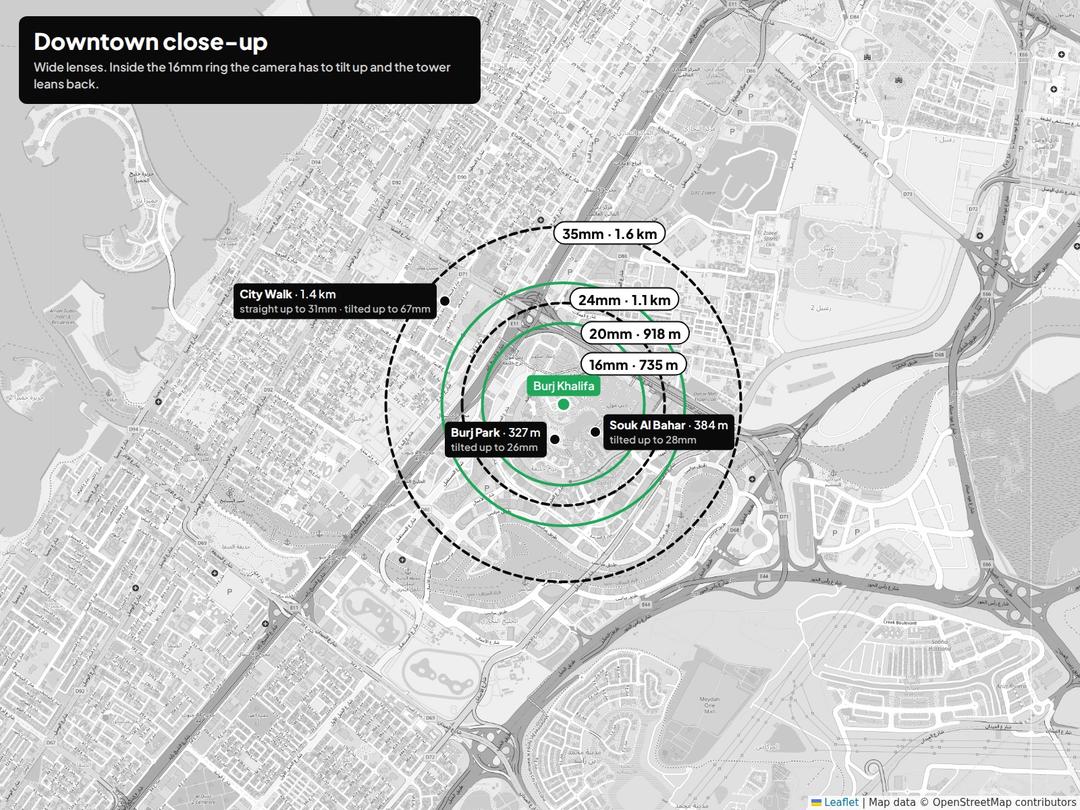
Downtown close-up: rings for 16, 20, 24 and 35mm (full frame, upright, level). Inside the 16mm ring the camera has to tilt up. Diagram by Camerahub; map data © OpenStreetMap contributors.
Which spot for which lens
- 16 to 28mm: Burj Park or Souk Al Bahar, tilted. You won't get the tower straight from there with any lens.
- 24 to 31mm, straight: City Walk.
- 50 to 68mm: Tolerance Bridge. A 50mm keeps the tower straight from here.
- 85 to 114mm: Dubai Frame or Al Jaddaf Walk.
- 135 to 200mm: The Viewing Point at Dubai Creek Harbour. A 135mm fits straight; a 200mm fits with a 2 to 5 degree tilt.
Honest caveats
- From far away, the base is usually hidden. Beyond about 1 km at ground level, other towers in Downtown and Business Bay usually block the lowest floors. The distances still tell you which lens fits the full 828 m height, but the bottom of your frame will be skyline, not the tower's base.
- Distances are measured on OpenStreetMap to the coordinates given. Standing elsewhere in the same park or promenade can change the distance by a few hundred metres, which changes the longest lens by 5 to 10mm.
- From far away, haze matters more than geometry. At 5 to 7 km, Dubai's dust and humidity often wash out the tower: go on a clear day, early in the morning or after rain. Our guide to shooting in dust and haze has more on that.
- Earth's curvature isn't a factor at these distances: it hides about 1 m of the base at 9 km.
- Drone and rooftop views aren't covered.
Sources
Distances and focal lengths were calculated by Camerahub (Brandmill) on 24 Nov 2026. Map data © OpenStreetMap contributors.
- Emaar, Burj Khalifa fact sheet (height to tip 828 m)
- Council on Tall Buildings and Urban Habitat, Skyscraper Center: Burj Khalifa
- Visit Dubai, Dubai Creek Harbour (promenade views of Burj Khalifa across the water)
- Gulf News, The Viewing Point at Dubai Creek Harbour (free entry, location)
- Hotels.com, best viewpoints in Dubai (Tolerance Bridge)
- Locationscout, Dubai Water Canal pedestrian bridge
- Locationscout, Dubai skyline at Al Jaddaf walkway
- Locationscout, City Walk night sky
- Photohound, Burj Khalifa view from Burj Park
- Chris and Wren's World, favourite Burj Khalifa photo spots
- One Million Places, Burj Khalifa photo spots
- OpenStreetMap copyright and licence
Frequently asked questions
How far away do I need to be to photograph the whole Burj Khalifa?
With a full-frame camera held upright and level, about 46 metres for every millimetre of focal length: 1,102 m with a 24mm lens, 2,296 m with a 50mm and 9,182 m with a 200mm. Tilting the camera up lets you stand closer.
Can I fit the whole Burj Khalifa in one photo from Burj Park?
Yes, with a lens of 26mm or wider on full frame (17mm on Sony APS-C), with the camera tilted up strongly. The tower will lean back. No lens keeps it straight from that close.
Which lens do I need for the Burj Khalifa from Dubai Creek Harbour?
From The Viewing Point at Dubai Creek Harbour, 7.1 km away, up to 155mm fits the whole tower with the camera level on full frame, and up to 310mm with a slight tilt. A 200mm fits with a 2 to 5 degree tilt.
Does an APS-C camera need a different distance?
Yes. Sony APS-C needs about 70.3 m per millimetre held upright and level, against 45.9 m on full frame. Use the focal length written on the lens: the APS-C table already includes the crop.
Sources
- Emaar, Burj Khalifa fact sheet (height to tip 828 m)
- Council on Tall Buildings and Urban Habitat, Skyscraper Center: Burj Khalifa
- Visit Dubai, Dubai Creek Harbour
- Gulf News, The Viewing Point at Dubai Creek Harbour
- Hotels.com, best viewpoints in Dubai (Tolerance Bridge)
- Locationscout, Dubai Water Canal pedestrian bridge
- Locationscout, Dubai skyline at Al Jaddaf walkway
- Locationscout, City Walk night sky
- Photohound, Burj Khalifa view from Burj Park
- Chris and Wren's World, favourite Burj Khalifa photo spots
- One Million Places, Burj Khalifa photo spots
- OpenStreetMap (map data © OpenStreetMap contributors)

About the editor
Wessel has worked in technology for more than 25 years and manages social media for some of the world's biggest brands. He knows which gear earns its place in a working creator's bag.
Related stories
15 most photogenic spots in the UAE: light first, GPS second
The most photogenic spots in the UAE fail at noon haze. Fifteen locations, golden-hour windows, etiquette and source-backed tips for Dubai to Fujairah.
Dubai Shopping Festival photography: nights, stages and Sole access
DSF and Sole DXB photography: concerts, nights, fireworks, Sole's written pro-camera approval, and UAE privacy rules.
HYROX Dubai camera policy 2026: what spectators can bring, and which rules say so
HYROX Dubai at Dubai Exhibition Centre, 27-28 November 2026: spectator tickets, the official photo rules, and what camera gear you can bring inside.