
How to photograph the Leonid meteor shower UAE in a modest year
How to photograph the Leonid meteor shower UAE in 2026: which nights sources name, Dubai moonset times, camera settings, dark-sky spots and desert safety.
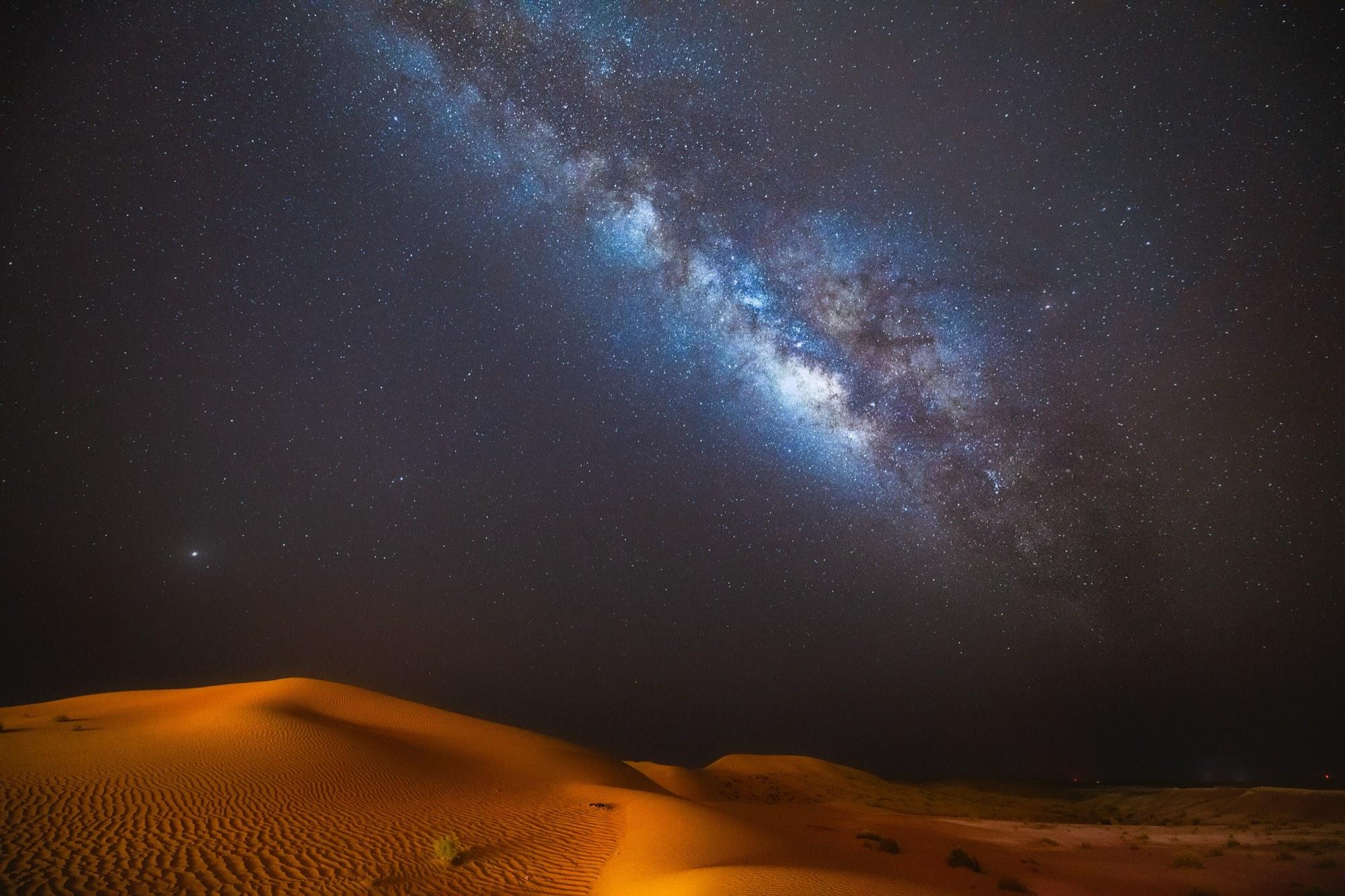
Key takeaways
- The International Meteor Organization's 2026 calendar puts a typical zenithal hourly rate (ZHR) at about 15, a modest year.
- A practical plan is to treat the night of Tuesday 17 to Wednesday 18 November 2026 as the main UAE window.
- Also try the night of 16 to 17 November after the 11:20 pm moonset, because NASA, AMS and the IMO web calendar label that night.
- NASA, reporting what observers have actually seen under dark skies in recent years, puts the rate at fewer than three an hour.
- Run NPF in PhotoPills for your body and lens; the guide often lands in the 10 to 25 second range.
- In an emergency, NSRC said to dial 995.
The Leonid meteor shower UAE window is already open. That's not a reason to expect a storm. The International Meteor Organization's 2026 calendar puts a typical zenithal hourly rate (ZHR) at about 15, a modest year. NASA's Leonids page is blunter: under dark skies, recent displays have often shown fewer than three meteors an hour.
Sources don't all name the same peak night. What you can plan is the timing, the dark hours after moonset, a wide, fast lens on a tripod, and a safe desert night. This guide sets out what each source says, then covers settings, a short list of places, and official safety advice. Nothing here is a field test. The figures come from the cited pages.
The Leonids are debris from comet 55P/Tempel-Tuttle, and they appear to radiate from Leo. The shower is active from 6 to 30 November 2026. IMO lists their speed at 71 km/s. They can be bright and sometimes colourful, but 2026 is an ordinary return.
Which night is the peak?
Several calendars disagree on how they label the peak night, so here is what each one says rather than inventing a single answer.
The IMO's 2026 calendar PDF is the most precise on the clock. It places the regular nodal maximum on 17 November at 23:45 UT, at solar longitude 235.27 degrees, with ZHR about 15. In the UAE (UTC+4), that is 3:45 am on Wednesday 18 November, so the local night of 17 to 18 November. The same PDF cites a Maslov (2007) model at 16:00 UT on 17 November (8:00 pm UAE time), still with a ZHR of about 15, and lists weak or low-level dust-trail encounters between 17 and 19 November. Jérémie Vaubaillon and Mikiya Sato, in notes cited by the IMO 2026 calendar, expect only low-density trail encounters: Vaubaillon says the 1800 trail will not produce a significant outburst; Sato says a modest increase is possible.
Other calendars don't all use that local night. The IMO and American Meteor Society web calendars, and NASA's Leonids page, label the peak night as 16 to 17 November. Time and Date, and Space.com citing the IMO calendar, describe the peak as around 17 to 18 November. Dubai Astronomy Group has booked a public night at Al Qudra Desert from 10:00 pm on 17 November to 2:00 am on 18 November. Some Gulf posts on X point to 17 to 18 as well; those posts are opinion, not a timing source.
| Source | What it says | Clock time |
|---|---|---|
| IMO 2026 calendar PDF | Regular maximum 17 Nov, 23:45 UT (3:45 am UAE on 18 Nov). Maslov model: 17 Nov, 16:00 UT (8:00 pm UAE). ZHR about 15. | 23:45 UT / 16:00 UT |
| IMO web calendar | Peak night 16 to 17 Nov. Moon 38% lit, waxing crescent. | None on the page |
| AMS web calendar | Peak night 16 to 17 Nov. Moon 39% lit, waxing crescent. | None on the page |
| NASA Leonids page | Peak night 16 to 17 Nov. Active 6 to 30 Nov. | None on the page |
| Time and Date | Peak around 17 to 18 Nov. Best between midnight and dawn. | No single minute |
| Dubai Astronomy Group | Event 17 Nov, 10:00 pm, to 18 Nov, 2:00 am, Al Qudra Desert. Programme lists "Peak of the Leonids" at 1:00 am. | Event timetable only |
A practical plan is to treat the night of Tuesday 17 to Wednesday 18 November 2026 as the main UAE window. The IMO 2026 calendar PDF places the regular maximum at 17 November 23:45 UT, which is 3:45 am UAE time on 18 November, after Dubai's moonset at 12:14 am and before astronomical twilight at 5:18 am. Also try the night of 16 to 17 November after the 11:20 pm moonset, because NASA, AMS and the IMO web calendar label that night. Give more weight to the clearer, darker forecast.
Moonset and the dark-sky window
You want the Moon down, and the sky still truly dark. Time and Date, for Dubai, lists first quarter at 3:47 pm on 17 November 2026. Illumination, calculated at lunar noon, is 41.3% on 16 November, 51.2% on 17 November and 61.3% on 18 November. The IMO web calendar quotes 38% and the AMS web calendar 39% for their 16 to 17 November peak night, a different method, so both sets of numbers are given here rather than blended.
| Night | Dubai moonset | Abu Dhabi moonset | Astronomical twilight (Dubai) | Sunrise (Dubai) |
|---|---|---|---|---|
| 16 to 17 Nov | 11:20 pm on 16 Nov | 11:25 pm on 16 Nov | 5:17 am on 17 Nov | 6:37 am on 17 Nov |
| 17 to 18 Nov | 12:14 am on 18 Nov | 12:19 am on 18 Nov | 5:18 am on 18 Nov | 6:37 am on 18 Nov |
Time and Date lists no moonset on 17 November itself, because the Moon goes down after midnight and the set is dated 18 November. Once it is down, you have a few dark hours before astronomical twilight. On the night of 17 to 18 November, the IMO PDF's 3:45 am UAE clock time sits inside that window. NASA's general advice is to start around local midnight, lie back, look up, and give your eyes time to adapt (NASA says in less than 30 minutes in the dark). Dim the phone. The radiant in Leo is better placed in the second half of the night.
The main UAE window: night of 17 to 18 November 2026
- 8:00 pm, 17 NovMaslov (2007) model time16:00 UT on 17 November, cited in the IMO 2026 calendar PDF, with a ZHR of about 15.
- 10:00 pm, 17 NovDubai Astronomy Group night startsPublic night at Al Qudra Desert.
- 12:14 am, 18 NovMoonset in DubaiAbu Dhabi moonset is at 12:19 am.
- 2:00 am, 18 NovDubai Astronomy Group session endsBefore the IMO PDF's 3:45 am clock time.
- 3:45 am, 18 NovIMO regular maximum23:45 UT on 17 November in the IMO 2026 calendar PDF, with ZHR about 15.
- 5:18 am, 18 NovAstronomical twilight (Dubai)
- 6:37 am, 18 NovSunrise (Dubai)
How many meteors will you actually see?
ZHR is not a promise of meteors over your dune. IMO defines it as the number an ideal observer would see in a perfectly clear sky, with a limiting magnitude of +6.5, and with the radiant overhead. For 2026, that figure is about 15.
WhatTheStar turns that ZHR into a more grounded estimate for a suburban (Bortle 5) sky with the Moon down: about 8.9 meteors an hour at best from 30 degrees north, and about 8.7 an hour from 15 degrees north. The UAE sits between those latitudes, so treat those figures as a nearby range, not a count measured here. NASA, reporting what observers have actually seen under dark skies in recent years, puts the rate at fewer than three an hour. Keep both numbers in mind. A handful of bright streaks would be a fair night. A storm would not.
Leonids 2026: three sourced rates, meteors an hour
Where to go, briefly
City glow will eat the faint ones. Check a current light-pollution map before you commit, and treat these places as starting points, not guarantees.
Al Qudra is the easiest of the usual names. Dubai Astronomy Group runs its Leonids night in Al Qudra Desert and says the road is paved, so a standard car is enough. Taxis and public transport do not reach the site; the pin is sent after booking. That's not the same as camping at Al Qudra Lakes, already covered in our guide to photogenic spots in the UAE. In 2018, Gulf News reported Dubai Municipality signboards there banning camping, bonfires, barbecues and vehicle entry. Whether that ban is still in force is unclear. A 2026 Dubai Municipality page restating or repealing it was not found, and a live Ministry of Climate Change and Environment (MOCCAE) page on Al Qudra Lakes still recommends overnight camping. Confirm the current rules with Dubai Municipality before you stay after dark.
Further out, Visit Abu Dhabi lists Liwa Oasis, at the edge of the Rub' al Khali, as a place to spend a night under the stars. Camping is allowed in Abu Dhabi, it says, but not on private land and not at the base of the dunes. Liwa is a longer drive and often a sandier one, so plan the vehicle and a daylight arrival.
Jebel Jais is promoted for stargazing by Ras Al Khaimah tourism, including Jais Viewing Deck Park at about 1,250 metres. The official park page lists opening hours of 8:00 am to 8:00 pm Sunday to Thursday, and 8:00 am to 11:00 pm Friday and Saturday. 17 November 2026 is a Tuesday, so those hours do not cover the after-midnight window. Don't plan to shoot meteors from a closed park. The Hatta area is another inland option to check on a light-pollution map, along with night-access rules.
Wherever you stop, private land needs permission, and photographing people is a separate question, covered in our guide to UAE photography laws. If a drone is part of the plan, read the UAE drone rules first.
Camera settings: wide, fast, and repeating
Meteors are quick and random, so shoot many timed stills. PhotoPills' meteor-shower guide sets out the method: a wide, fast lens under 35mm, often at f/2.8 or wider; locked manual focus; a shutter short enough to keep stars as points; a high ISO your camera can bear; and an intervalometer running for hours.
Sony rates the Alpha 7S III's 12.1-megapixel full-frame sensor at a standard stills ISO of 80 to 102,400, expandable to 40 to 409,600. Use the highest ISO you're willing to live with on your own camera. PhotoPills suggests 1600, 3200, 6400 or higher, depending on the body, as a starting range, not a recipe we have tested. Two E-mount primes fit the wide, fast brief on paper: the Sony FE 14mm F1.8 GM, a 14mm full-frame prime (21mm equivalent on APS-C) with an f/1.8 maximum aperture that Sony describes as suited to low light, and the Sony FE 20mm F1.8 G, a slightly tighter ultra-wide with the same f/1.8 maximum. More wide options are in our Sony E-mount lenses guide. Put the camera on a firm tripod and switch stabilisation off, as PhotoPills advises when the camera is already locked down.
The 500 rule for shutter speed is 500 divided by the effective focal length: about 36 seconds on a 14mm full-frame lens. PhotoPills warns that this often leaves small trails on modern cameras, and prefers the NPF rule, from Frédéric Michaud and the Société Astronomique du Havre, which also takes in sensor size, resolution, aperture and star declination. Run NPF in PhotoPills for your body and lens; the guide often lands in the 10 to 25 second range. Check a test frame at 100%.
Shutter speed: 500 rule vs NPF rule, in seconds
Focus manually by magnifying a bright star until it is the smallest point you can make, then lock it. Shoot RAW, and turn long-exposure noise reduction off. On the Alpha 7S III, Interval Shoot sits under MENU, Shooting, Drive Mode, Interval Shoot Func., with a 1 to 60 second interval measured from the start of one exposure to the start of the next. PhotoPills suggests a 2 to 5 second gap between frames. The help guide notes that a weak battery or a full card can stop the sequence early, and suggests USB power if you have it. Carry spare batteries and keep them warm. For dew and sand, use the same care as in our guide to protecting a camera from heat, sand and humidity. Stacking the frames that caught a meteor is optional.
Desert safety
The desert is why the sky is dark, and it's also the main risk. On 6 February 2026, Gulf Today reported that the UAE National Search and Rescue Centre asked residents and visitors to follow its precautions for desert trips: check the vehicle; carry a spare tyre, a tow rope and a shovel; take extra fuel, food and water; use GPS or offline maps; set out your start point, destination and stops; travel in a group; carry a first-aid kit; dress for the weather; keep the phone charged, with a portable solar charger; and tell your family the itinerary. In an emergency, NSRC said to dial 995. The official UAE list of emergency numbers also gives 995 for search and rescue, and 999 for police.
Visit Abu Dhabi's camping advice adds a few plain limits: pack warm clothes, check tyre pressures and fluid levels, do not camp on private land, and do not pitch at the base of a dune. November nights can turn cold once you stop moving, so take layers, not only water. Go with someone if you can, and agree a check-in time with a person who is not on the trip.
If you'd rather not navigate the dunes on your own, Dubai Astronomy Group's booked night is a structured alternative, with a paved approach and a published timetable. The session ends at 2:00 am, which is before the IMO PDF's 3:45 am clock time, so independent shooters who want that later window need their own plan and their own way home.
Sources
All accessed 10 Nov 2026.
- IMO - 2026 Meteor Shower Calendar (PDF)
- IMO - 2026/2027 Meteor Shower Calendar (web)
- American Meteor Society - 2026/2027 Meteor Shower Calendar
- NASA Science - Leonids
- Time and Date - Leonid Meteor Shower 2026
- Time and Date - Moonrise, moonset and phases in Dubai, November 2026
- Time and Date - Moonrise, moonset and phases in Abu Dhabi, November 2026
- Time and Date - Moon phases 2026 for Dubai
- Time and Date - Sunrise and sunset in Dubai, November 2026
- WhatTheStar - Leonids 2026
- Space.com - Leonid meteor shower 2026
- Dubai Astronomy Group - Leonids Meteor Shower 2026 event
- PhotoPills - Meteor Showers 2026: The Definitive Photography Guide
- PhotoPills - 500 rule and NPF Spot Stars calculator
- Sony - FE 14mm F1.8 GM (SEL14F18GM)
- Sony - FE 20mm F1.8 G (SEL20F18G)
- Sony - Alpha 7S III (ILCE-7SM3)
- Sony Help Guide - Alpha 7S III Interval Shoot Func.
- Visit Abu Dhabi - 10 best places to camp in Abu Dhabi
- Visit Ras Al Khaimah - Best stargazing locations
- Visit Jebel Jais - Jais Viewing Deck Park (hours)
- Gulf News - Ban on camping, bonfire, barbecue, dog walking in Al Qudra Lake (1 Nov 2018)
- Gulf Today - Follow safety rules during desert trips (6 Feb 2026), citing the UAE National Search and Rescue Centre
- UAE official portal - Handling emergencies (995 search and rescue; 999 police)
- MOCCAE - Al Qudra Lakes
Frequently asked questions
Which nights should I photograph the Leonid meteor shower UAE in 2026?
Treat the night of Tuesday 17 to Wednesday 18 November 2026 as the main window. The IMO 2026 calendar PDF puts the regular maximum at 17 November 23:45 UT, which is 3:45 am UAE time on 18 November, after Dubai's moonset at 12:14 am and before astronomical twilight at 5:18 am. Also try the night of 16 to 17 November after the 11:20 pm moonset, because NASA, AMS and the IMO web calendar label that night.
How many Leonids will I actually see from the UAE?
IMO's ZHR for 2026 is about 15, an ideal-sky figure. WhatTheStar estimates about 8.9 an hour at best at 30 degrees north, with the Moon down. NASA says recent dark-sky rates have often been fewer than three an hour. Expect a modest night.
What camera settings should I start with for the Leonids?
Use a wide, fast lens, manual focus on a star, a shutter from the NPF rule (or a shortened 500 rule), and an ISO your camera can handle, then shoot a long interval sequence in RAW. PhotoPills says NPF often lands between 10 and 25 seconds.
Where is a good place to photograph a meteor shower in the UAE?
Start with a dark site away from city light, then confirm access. Al Qudra Desert is the most reachable of the usual names, and Liwa is farther. Jebel Jais is a known stargazing area, but the official viewing-deck hours do not cover a weekday after midnight.
What safety steps matter on a desert night under the Leonids?
Follow the National Search and Rescue Centre's list: a checked vehicle, spare tyre, shovel and tow rope, extra fuel, food and water, offline maps, a group if you can, warm clothes, a charged phone, and a person at home who has your plan. NSRC's reported emergency number is 995.
متى أصور شهب الأسديات في الإمارات؟
شهب الأسديات هو الاسم العربي لزخة شهب الأسد (the Leonids). الليلة الأساسية هي من الثلاثاء 17 إلى الأربعاء 18 نوفمبر 2026. تقويم منظمة النيازك الدولية (IMO) لعام 2026 يضع الذروة عند الساعة 23:45 بالتوقيت العالمي يوم 17 نوفمبر، أي الساعة 3:45 فجراً بتوقيت الإمارات يوم 18 نوفمبر، بعد غياب القمر في دبي عند 12:14 فجراً وقبل الشفق الفلكي عند 5:18 فجراً. يُستحسن أيضاً محاولة ليلة 16 إلى 17 نوفمبر بعد غياب القمر عند 11:20 مساءً، لأن ناسا وجمعية النيازك الأمريكية (AMS) وتقويم IMO على الويب يسمون تلك الليلة.

About the editor
André has shot weddings for almost ten years, where every moment happens once and the story has to be caught as it unfolds. He brings that eye for real moments to everything he reviews.
Related stories
Moon Jupiter conjunction November 2026: how to photograph it from the UAE with a Moon frame and a planet frame
Moon Jupiter conjunction November 2026: how to photograph the Moon, Jupiter, Mars and Regulus before dawn on 30 Nov from the UAE, with a bracket plan.
How to photograph the supermoon: the UAE's Beaver Moon rises before sunset on 24 November
How to photograph the supermoon in the UAE on 24 November: Dubai moonrise 5:06 pm, disc exposure, foregrounds, and DAG's night at SEE Institute.
Shooting in 45°C: How to Protect Your Camera from Heat in the UAE
Keep stills and video cameras working in UAE heat: operating temps, condensation tips, sand protection, batteries and a practical kit list.